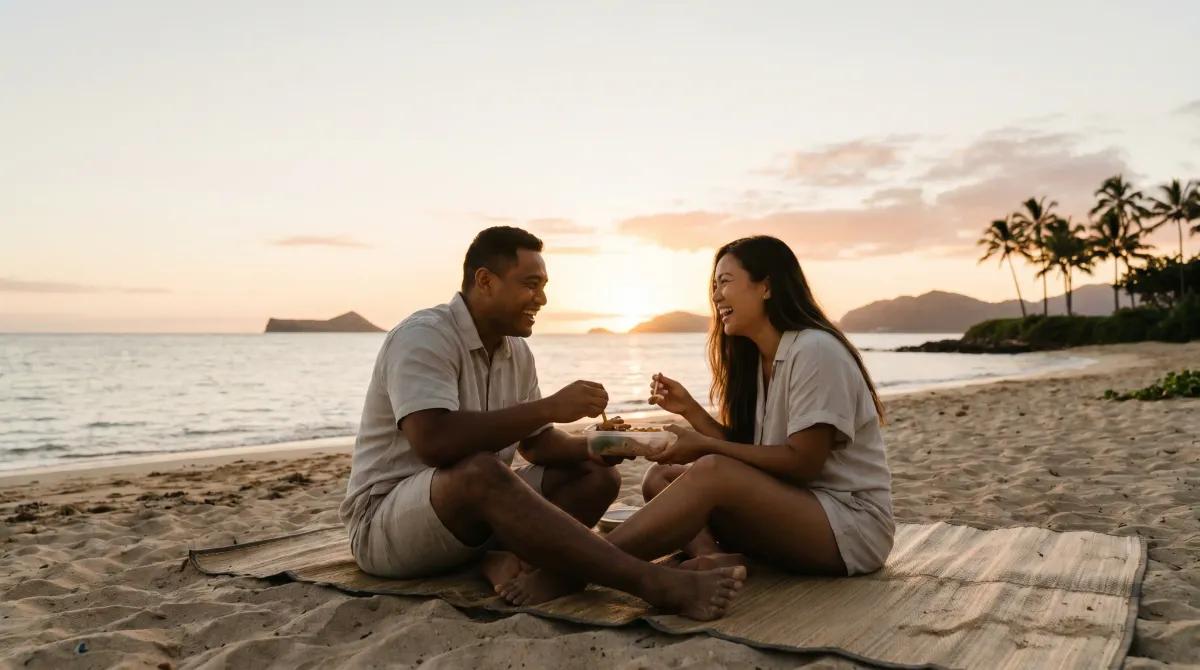
In Hawaii, dating across cultures is not a trend or a statement. It is simply how the islands work. Hawaii has the highest interracial marriage rate of any U.S. state, no racial majority group, and the largest share of multiracial residents in the country. For singles here, a relationship that blends two or three heritages is not the exception. It is closer to the default.
This guide pulls together the real, verifiable numbers behind that reality, then explains what they mean for actually dating and building a relationship in the islands. Everything below is sourced to the U.S. Census Bureau, the Pew Research Center, and other reputable institutions, with the year attached so you can trust it.
TL;DR
Hawaii has the highest rate of interracial marriage of any U.S. state, and the Honolulu metro area leads all U.S. metros, with 42 percent of newlyweds married to someone of a different race or ethnicity (Pew Research Center).
No racial group is a majority in Hawaii. The state is roughly 37 percent Asian, 25 percent White, 24.5 percent two or more races, 10 percent Native Hawaiian or Pacific Islander, and 10 percent Hispanic (U.S. Census Bureau), giving it the nation's highest share of multiracial residents.
This mix is rooted in plantation-era immigration and has produced a "local" identity, a shared food culture, and the Pidgin language, all of which make multicultural dating feel normal here in a way it rarely does on the mainland.
Key Findings
Hawaii is not just diverse. It is diverse in a structurally different way from anywhere else in the United States. The Census Bureau's Diversity Index, which measures the chance that two randomly chosen people are from different racial or ethnic groups, ranked Hawaii first in the nation in 2020. As the Census Bureau put it, "Hawaii had the highest DI in 2020 at 76%, which was slightly higher than its 75.1% DI in 2010." It is also the only state where Asian residents are the largest group and where no group forms a majority.
That structure shows up directly in who pairs off, who marries, and who is born. The numbers below are the backbone of this post.
The data: Hawaii's diversity and intermarriage, by the numbers
Here is the verified picture, with sources and years.
Measure | Figure | Source (year) |
|---|---|---|
Interracial marriage rank among states | Highest in the U.S. | Pew Research Center (2012) |
Newlyweds intermarried, Honolulu metro | 42% (highest of any U.S. metro) | Pew Research Center (2017) |
Newlyweds intermarried, Hawaii statewide | 42% (2008 to 2010) | Pew Research Center (2012) |
Infants who are multiracial or multiethnic | 44% (highest of any state) | Pew Research Center (2017) |
Two or more races | 24.5% | U.S. Census Bureau ACS (2020 to 2024) |
Asian alone | 37.4% | U.S. Census Bureau ACS (2020 to 2024) |
White alone | 25.1% | U.S. Census Bureau ACS (2020 to 2024) |
Native Hawaiian and Other Pacific Islander alone | 10.4% | U.S. Census Bureau ACS (2020 to 2024) |
Hispanic or Latino (any race) | 10.2% | U.S. Census Bureau ACS (2020 to 2024) |
Black alone | 2.2% | U.S. Census Bureau ACS (2020 to 2024) |
Diversity Index | 76% (highest state) | U.S. Census Bureau (2020) |
A few clarifications, because precision matters here. The 42 percent Honolulu figure comes from the Pew Research Center's 2017 report on intermarriage, analyzing Census data from 2011 to 2015, and it was the highest of the 126 metro areas Pew studied, ahead of Las Vegas (31 percent) and Santa Barbara (30 percent). The statewide 42 percent figure is a separate finding from Pew's earlier 2012 report using 2008 to 2010 data, which named Hawaii the highest state for newlywed intermarriage. They are different studies and different geographies that happen to land on the same number.
For national context, about 17 percent of U.S. newlyweds were intermarried in 2015, up from 3 percent in 1967, the year the Supreme Court struck down remaining bans on interracial marriage in Loving v. Virginia (Pew Research Center). Hawaii's rate is more than double the national figure.
On the multiracial side, the Pew Research Center found in 2015 that Hawaii has the largest share of multiracial residents of any state. Notably, Hawaii is the only state where the largest multiracial group is a tri-racial combination, people who are some mix of White, Asian, and Native Hawaiian or Pacific Islander. An academic study by sociologists Xuanning Fu and Tim Heaton, published in 1997 and analyzing Hawaii Department of Health marriage records from 1983 to 1994, found that about 45 percent of marriages in the state during that period were interethnic or interracial, showing this is a decades-old pattern, not a recent one.
Why Hawaii is so mixed: the plantation story
None of this happened by accident. Hawaii's multicultural makeup traces directly to its sugar and pineapple plantation era. Beginning in the 1850s, plantation owners recruited waves of contract laborers from around the world: Chinese workers first, followed by large numbers of Japanese, then Portuguese, Puerto Ricans, Koreans, and Filipinos, along with smaller groups. On December 23, 1900, the ship Rio de Janeiro entered Honolulu harbor carrying the first significant group of Puerto Ricans brought to Hawaii for plantation work, and from 1907 to 1931 roughly 120,000 Filipino laborers (the sakada) came to the islands.
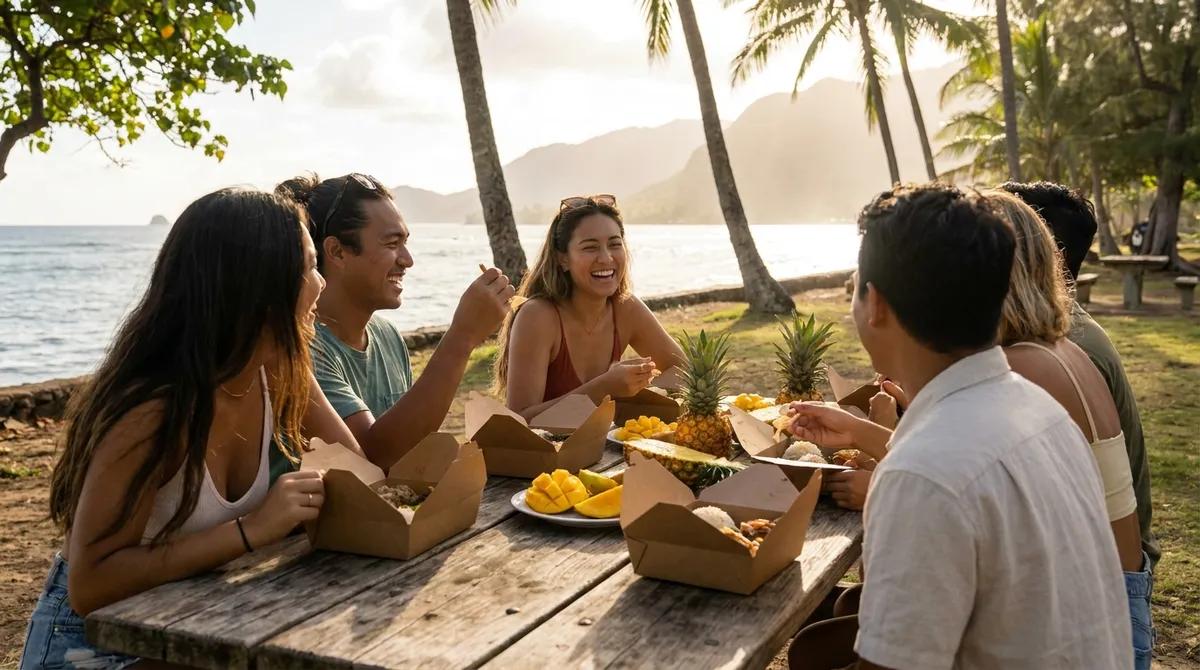
These groups lived and worked side by side, often in plantation camps. Out of that mixing came two things central to island life today. The first is a shared "local" food culture, symbolized by the plate lunch and the "mixed plate," where Japanese, Filipino, Korean, Portuguese, Chinese, and Hawaiian dishes share one plate. The second is Hawaiian Pidgin, formally Hawaii Creole English, a full language that blends English, Hawaiian, Japanese, Portuguese, Chinese, and Filipino. The U.S. Census Bureau first recognized it as a language in 2015, after its American Community Survey identified residents who reported speaking "Pidgin" and "Hawaiian Pidgin" at home.
It is worth holding the harder history alongside this. The plantation system deliberately divided workers by ethnicity, sometimes paying different wages by nationality to discourage organizing. And the Native Hawaiian population had already been devastated by introduced disease after Western contact in 1778. According to demographer David Swanson's analysis cited by the Pew Research Center in 2015, the population "had declined by 48% since Cook set foot on Hawaii" by 1800, "had declined 71%" by 1820, and was down 84 percent by 1840, falling from an estimated 683,000 to around 109,000. The "melting pot" image is real, but it sits on top of a complicated and often painful past, which is part of why cultural respect matters so much in the islands today.
What "local" and "hapa" actually mean
Two words come up constantly and are worth understanding before you date here.
"Local" in Hawaii is a cultural identity, not simply a description of where you live now. It generally refers to people who grew up in the islands, often with mixed Asian, Native Hawaiian, and other plantation-era roots, and who share the values and customs of island life. It is not the same as being a recent transplant, and it is not strictly about any single race. We unpack this in more depth in our guide to dating culture in Hawaii for newcomers.
"Hapa" is a Hawaiian word meaning "part" or "half," now widely used to describe people of mixed ethnic heritage. In a state where 24.5 percent of residents identify as two or more races, hapa identity is ordinary and visible, woven through families, classrooms, and friend groups everywhere.
What this means for dating in the islands
So what does all of this data actually change about your dating life? Several real things.
Interracial dating is unremarkable here. On much of the mainland, couples of different backgrounds still report stares, questions, or family friction. In Hawaii, with 44 percent of babies born to parents of different races or ethnicities, mixed couples are simply part of the landscape. Nationally, acceptance has risen sharply too: the share of U.S. adults saying more interracial marriage is good for society climbed from 24 percent in 2010 to 39 percent in 2017 (Pew Research Center). In Hawaii, that acceptance has been the lived norm for generations. For more on how this plays out day to day, see our honest look at what dating in Hawaii is really like.
Family and food carry real weight. The flip side of a deeply multicultural society is that you are rarely just dating one person. You are meeting their ohana. Family approval matters, gatherings revolve around shared meals, and a willingness to show up, eat the food, and learn the customs of a partner's heritage goes a long way. This is true whether your partner's family is Filipino, Japanese, Native Hawaiian, Portuguese, or some blend of several.
Blending traditions is expected, not exceptional. Island weddings routinely fold together customs from multiple branches of a family, alongside Hawaiian elements like the lei exchange. Couples here tend to be practiced at combining holidays, foods, languages, and rituals, because most of them grew up doing exactly that.
The genuine challenges are cultural, not racial. Therapists who work with interracial couples report that the friction points tend to be things like differing family expectations, communication styles, and traditions, rather than race itself. In Hawaii, the surrounding society removes much of the external pressure that strains mixed couples elsewhere, but the work of merging two family cultures still takes communication and respect. Couples who talk openly about expectations early tend to do best.
A note on respect: Native Hawaiian culture is not just one ingredient in the mix. It is the indigenous culture of these islands, with its own language, history, and ongoing sovereignty conversations. Engaging with it thoughtfully, rather than treating it as decoration, is part of dating well here.
How dating differs across the islands
The multicultural norm holds across all six main islands, but the dating scene varies by place. Honolulu and Oahu offer the largest and most varied pool, which we break down with data in our local's guide to dating in Honolulu. Maui blends a tight-knit local community with a steady flow of new arrivals, covered in our complete guide to dating in Maui. And smaller islands like Kauai have a more intimate scene where everyone knows everyone, explored in our practical guide to meeting singles in Kauai.
Wherever you are, the apps matter too, and which one you use makes a difference in a market this specific. We compare the options in our honest local guide to Hawaii dating sites and apps.
Recommendations
If you are dating in Hawaii and want to make the most of its multicultural reality, here is a practical path.
Lead with curiosity, not assumptions. Ask about your partner's heritage, foods, and family traditions instead of guessing. In a state this mixed, most people carry more than one culture, and few things land better than genuine interest.
Take family seriously and early. Expect to meet the ohana sooner than you might on the mainland, and treat those gatherings as central, not optional. Show up, bring food, learn names.
Learn the cultural basics. Understand what "local" and "hapa" mean, treat Pidgin as a real language rather than a novelty, and approach Native Hawaiian culture with respect. These signal that you are paying attention.
Name expectations out loud. The real challenges in mixed relationships are about traditions, holidays, and family roles. Talk through them directly rather than assuming alignment.
Choose your platform for the market. A Hawaii-focused dating site filters for people who actually live here and understand island culture, which matters more in a place this distinct.
The benchmark that should shift your approach is simple: if a relationship is getting serious, the question is no longer just whether you two fit, but whether your families and traditions can blend. In Hawaii, that conversation is normal, and most people are well practiced at it.
Caveats
A few honest limits on the data. The headline Honolulu and statewide intermarriage figures of 42 percent come from Pew Research Center analyses of Census data from 2008 to 2010 and 2011 to 2015 respectively, so they are the most authoritative figures available but not brand new; Pew has not published an updated metro-by-metro intermarriage study since. The racial and ethnic percentages are from the Census Bureau's American Community Survey 2020 to 2024 estimates and shift slightly year to year. Because Hawaii's race categories overlap (Hispanic residents may be of any race, and "two or more races" pulls from every group), the percentages are not meant to sum neatly to 100. Finally, broad statistics describe a population, not any individual; they tell you the islands are unusually open to multicultural relationships, not how any one person or family will feel.
Meet people who actually live here
Hawaii's dating world reflects the islands themselves: mixed, family-centered, and refreshingly free of the baggage that still surrounds interracial dating in much of the country. The best way to experience it is to meet people who genuinely live here and know the culture. HawaiiDating.net is a free, Hawaii-focused dating platform built for locals and people putting down roots in the islands, not tourists passing through. It is free to join, free to create a profile, and free to start browsing. If you want to meet someone who gets island life, that is the place to start.